
 Defne Yucesoy
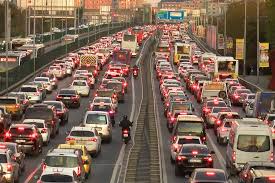
There’s a moment where everyone that spends a good amount of time in Istanbul recognizes. You’re sitting in traffic, the honking of the cars hurt your ears, you’re barely moving and the minutes slip away as the city hums around you. It’s easy to blame the drivers and the cars switching lanes but the explanation is actually simpler than you think. Millions of people are stuck with the same problem everyday. The issue isn’t individual behavior, it is the system itself.
Istanbul’s traffic isn’t just a driving problem, it is the policy itself.
Firstly, over the past years Istanbul has become one of the biggest cities in the world. Population growth, rising incomes etc. have all led to one obvious outcome : more cars. However, while the number of cars increased drastically the infrastructure has been kept the same. This creates a imbalance. When demand for road space exceeds supply, traffic jam becomes unavoidable. It’s not about how people drive, it’s more about how many people are forced to drive in the first place.
And that “force” is where policy comes in.
In assumption traffic can be reduced if people have accessible alternatives to driving. Yes, Istanbul does have many public transportation lines such as metro lines, busses and ferries but they are often overcrowded, inconsistent, or insufficiently connected across the city. For many individuals (especially for those commuting between distant parts of the city) driving becomes less of a choice and more of a necessity.This indicates a bigger issue which is transportation policy has not fully adapted to the city’s scale. Expanding roads without equally prioritizing public transit only delays the problem and it doesn’t solve it.
It’s tempting to reduce Istanbul’s traffic to frustration with drivers. But that misses the larger picture. Traffic is not simply the result of bad decisions made by individuals. Traffic is the outcome of decisions made at a policy level. When a city consistently produces congestion, the issue is no longer personal. It is structural. And until it is treated that way, Istanbul will remain a city where movement is constant ,but progress feels really slow.
Image credit:
“Drivers in Istanbul Lose 105 Hours a Year in Traffic Jams.” Hispanatolia, https://hispanatolia.com/en/drivers-in-istanbul-lose-105-hours-a-year-in-traffic-jams/. Accessed 11 Apr. 2026.